
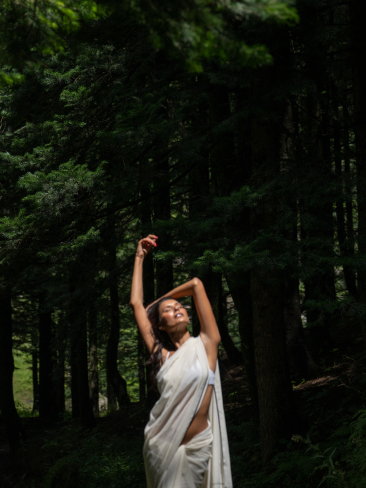
Beyond Skincare
Anita Lal, Margaret Karlinsky and Greg Payne on science, ritual and creating a new philosophy of beauty
Q. When you began creating iti, what was the intention?
Anita Lal: I didn't want to create just another skincare brand. I wanted to create something that felt deeply rooted in India—its landscapes, botanicals and wisdom—but interpreted through modern science. Above all, I wanted skincare that was safe. Safety was my starting point. But it also had to be effective and joyful. I wanted products that cared for the skin while uplifting the spirit. Fragrance, texture and the sensory experience were never afterthoughts; they were integral to the philosophy.
Margaret Karlinsky: That philosophy shaped every formulation. We wanted products that respected both the skin and the environment, using botanicals where they perform beautifully while combining them with scientifically proven ingredients that support the skin's natural biology.
Q. There is often a perception that choosing botanicals means compromising on efficacy. Is that true?
Margaret: Not at all. It depends on what you're trying to achieve. If someone has a complex skin condition, stronger therapeutic ingredients may be appropriate. But everyday skincare serves a different purpose. It should support healthy skin rather than constantly trying to correct it.
Anita: That's exactly how we approached iti. As we age, the skin naturally produces less collagen, loses hydration and becomes less resilient. Rather than forcing the skin to behave differently, we wanted to replenish what it's naturally losing over time. Supporting hydration, strengthening the barrier and maintaining resilience—that's what healthy skincare should do every day.
Q. So where does science fit into a botanical philosophy?
Margaret: Nature and science aren't opposites. Some ingredients the skin benefits from simply don't exist in plants. Ingredients like niacinamide or biomimetic actives have an important role because they're already compatible with the skin.
Anita: We've never believed in choosing between nature and science. We choose whatever is safest and most effective. The Himalayas and Ayurveda offer extraordinary botanical wisdom, while modern science helps us understand how to unlock that potential responsibly.
Q. Greg, you've spent decades designing luxury spa experiences around the world. What stood out to you about iti?
Greg Payne: The first thing was that it never felt like a collection of products. It felt like a complete experience. Whenever we create a treatment, we begin by asking a simple question: What do we want the guest to feel? From there, every decision follows—the products, the sequence, the textures, the aromas and even the pace of the treatment.
A treatment should certainly deliver visible benefits, but it should also feel luxurious, deeply nurturing and leave people with a better understanding of how to care for themselves beyond the spa.
Q. Anita, you often speak about routine becoming ritual. What's the difference?
Anita: A routine is something we do habitually. It looks after us, but often without much thought. A ritual is different. It engages every part of us—our senses, our emotions, our memories. The products become only one part of a much larger experience.
When fragrance, texture and mindful application come together, you're no longer simply caring for your skin. You're caring for yourself.
Q. How important is scent in creating that experience?
Greg: It's absolutely fundamental. Scent has the extraordinary ability to transport us. It creates memory, emotion and a sense of place. That's why continuity matters. If the entire ritual is built around rose or jasmine, supported by sandalwood, it creates harmony rather than sensory overload.
You're no longer simply treating dry skin or dehydration. You're creating an atmosphere that allows someone to completely switch off.
Anita: I've always believed that fragrance brings joy. I couldn't imagine creating skincare without the beauty of jasmine, rose, neroli or sandalwood. These are fragrances that belong to this land and evoke a feeling of home, comfort and calm. Using pure essential oils rather than generic fragrance blends makes an extraordinary difference to the experience.
Q. So skincare becomes something much bigger than skincare?
Greg: Absolutely. People think they're coming for a facial, but in reality you're affecting them on many different levels. The products touch the skin, the aromas influence memory and emotion, and the ritual creates space to pause. It becomes restorative rather than simply corrective.
Margaret: That's why layering is so important. Every product performs individually, but together they create an experience that's greater than the sum of its parts.
Q. Is that ultimately what iti is trying to create?
Anita: Yes. Beautiful skin is one outcome, but it isn't the only one. We wanted to create moments of care that people could return to every morning and every evening. Moments that nourish the skin, calm the mind and gently lift the spirit.
To me, that is what luxury should feel like. Not excess, but presence. Not transformation overnight, but a lifelong relationship with your skin—and with yourself.