

Beauty Begins Beneath the Surface
Beauty Begins Beneath the Surface by Simran Lal
We often think of beauty as something we achieve. A better routine, another product, a new treatment—always searching for the next improvement. But what if beauty didn't begin with fixing ourselves? What if it began with recognising that we are already whole?
This is one of the most profound ideas in the Vedas. The starting point is purna—the belief that we are complete within ourselves. Rather than seeing beauty as something to be pursued, it invites us to see it as something that already exists, waiting to be recognised.
It is a subtle shift in perspective, but one that changes everything.
When we stop looking only at the surface, we begin to notice something deeper: an extraordinary web of relationships that connects our minds, our bodies and the natural world. In the Vedic tradition, this harmony is known as ṛta—the underlying rhythm that sustains life. It reminds us that wellbeing is never isolated. The way we think, the stories we tell ourselves, the choices we make each day and our relationship with nature are all interconnected.
This understanding also transforms the way we think about wellbeing. The Sanskrit word svasthya, often translated as health or wellbeing, carries a richer meaning. It is derived from sva, meaning "the self", and stha, meaning "to be established" or "to be grounded". Together, they suggest a state of being deeply rooted in oneself—feeling at ease, centred and in harmony.
Viewed through this lens, wellbeing becomes less about perfection and more about alignment. It asks us to consider what truly nourishes us. Is it the way we begin our mornings? The conversations we have with ourselves? The food we eat, the time we spend in nature, the moments we create for rest? These choices may seem small, but together they shape how we experience ourselves every day.
This philosophy also changes the way we approach skincare.
We often speak about routines—those familiar sequences we repeat each morning and evening. Routines have an important role. They create consistency and help us care for ourselves even on the busiest days.
But there is another way of approaching these everyday moments: as rituals.
The difference is not in the products we use, but in the attention we bring to them.
A routine is often habitual, something we move through almost automatically. A ritual, by contrast, asks for presence. It invites intention, awareness and a moment of pause.
Nowhere is this more meaningful than in skincare. Our skin is the body's largest organ. It absorbs what we place upon it and reflects so much of our internal wellbeing. Choosing what we apply therefore becomes more than a cosmetic decision—it becomes an act of awareness.
When we slow down, skincare becomes less about changing the way we look and more about changing the way we relate to ourselves.
The Vedas regard the body as something sacred rather than something to be corrected. If every aspect of nature is worthy of reverence, why shouldn't we extend that same care towards ourselves?
This is where a simple routine can become a ritual.
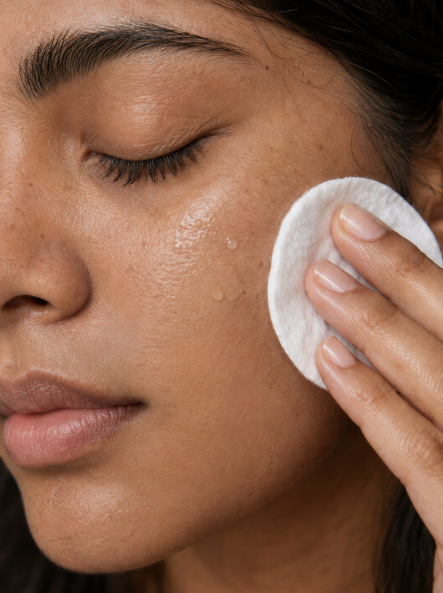
On some mornings, life demands efficiency. We cleanse, moisturise and move on. There is beauty in that consistency. But on quieter days, the very same actions can become something else entirely. Applying a serum or massaging in a cream becomes an opportunity to pause, breathe and acknowledge ourselves with kindness.
The action remains the same. The intention transforms the experience.
Perhaps that is the most enduring lesson of Vedic wisdom. Beauty is not found in perfection, nor is wellbeing achieved through a single product or practice. Both emerge through awareness—through the choices we make, the rhythms we honour and the relationship we cultivate with ourselves over time.
Because true beauty does not begin with correction. It begins with presence.